I recently did a project for school where I had to find a new article about some sort of science, and luckily for me, my mom had just sent me an article from the New York Times about evidence of Vikings in the Americas 1000 years ago (shout out to my mom!). The article (and of course the study itself) is in the same vein as Archaeology and Anthropology, so I thought that I would share what I learned on here too!
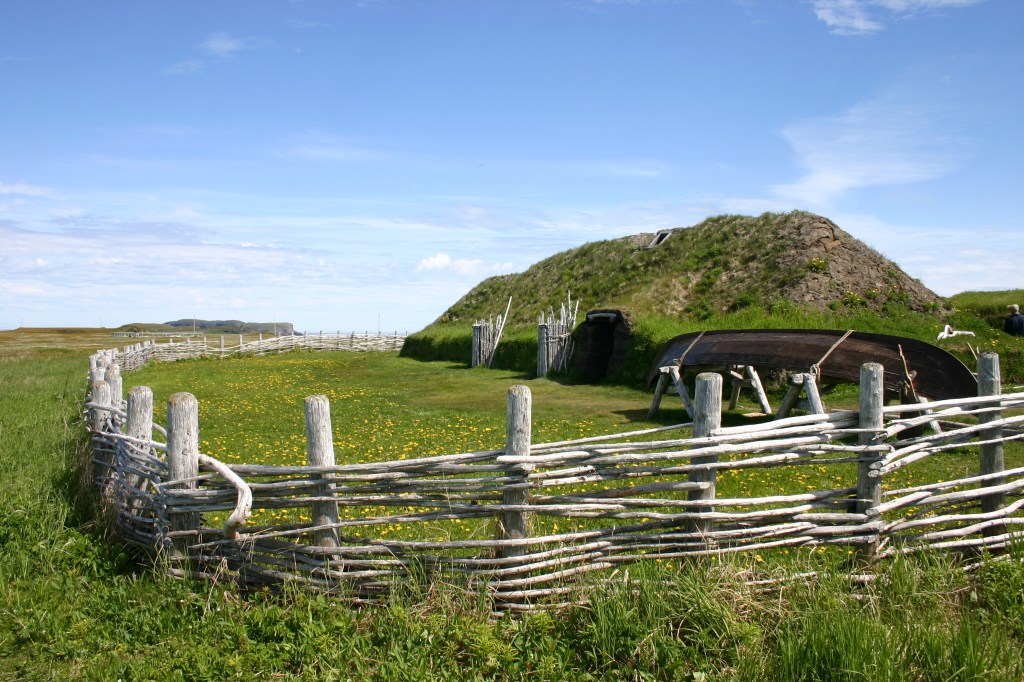
The article (linked below) discussed a study that was recently published, centering around a site in Canada called L’Anse aux Meadowes and how scientists used an extremely rare astrophysical occurrence to determine exactly when this site was inhabited. The remains of the settlement, located in the northern tip of Newfoundland, Canada, were first discovered in the 1970s by a pair of archaeologists. Scientists have long known that Vikings did come to the Americas and knew that L’Anse aux Meadowes was Viking because its buildings resembled Viking buildings in Greenland and many artifacts found were Norse in style, yet they never knew exactly when the site was inhabited. However, as discussed in both the NYT article and the actual study, a team of scientists was able to utilize dendrochronology (the study of tree rings) and their knowledge of Miyake Events to determine exactly when the Vikings were there.
Scientists had used radiocarbon dating for this site before, but they struggled to get an exact date because the artifacts found span the whole Viking Age. However, they recently used the rings of trees and an imprint of an extremely rare solar storm to get a year. Scientists collected three pieces of wood from different trees from L’Anse aux Meadows, each still having their outer ring of bark, to analyze. They also observed that the pieces of wood had been cleanly cut with metal tools, which the local native people did not use at that time, another clue that this settlement was a Viking settlement. Then, the scientists isolated the carbon in each of the tree rings of the wood, and found a distinct uptick in the amount of Carbon-14 28 rings before the outer bark in each piece of wood. Radioactive Carbon-14 normally is only a small fraction of the carbon in the atmosphere, and the ratio of Carbon-12 to Carbon-14 remains steady year to year, but in 2012, researchers in Japan discovered that there is a very rare occasion in which there is a sharp increase in Carbon-14, caused by what is now known as a Miyake Event. Because Carbon-14 is produced when cosmic rays from the sun interact with Earth’s atmosphere, this means that a Miyake Event occurs when there is a flare, or increase, in cosmic rays. This only happens very occasionally, but when it does, it can be observed in trees all over the world. Scientists elsewhere had already observed that there had been one of these Miyake Events in the years 992 to 993 (thanks to the extremely old Italian tree, Italus), so the scientists who were studying L’Anse aux Meadows were able to connect the dots and realize that this uptick of Carbon-14 in these trees must be in relation to that Miyake Event. Once they knew that the 28th ring in was 993, all they had to do was count the rings out to the outer bark and land on 1021.
This article was really interesting to me because it demonstrated the interaction between so many different kinds of science: Biology, Chemistry, Dendrochronology, Astrophysics, and of course Archaeology. It is also super intriguing because these Viking expeditions are currently the earliest known modern interactions between the Eastern and Western hemispheres, predating Columbus by about 470 years. There is still so much unknown: did the Vikings interact with the Native peoples? If so, how? What happened to those Vikings who came to the Americas? Did they stay? Did they intermix with the Natives? Did they go back to Europe? Why do we know so little about them? Obviously these questions aren’t answerable yet, but I am truly very excited to see where future investigations of this topic go!
NYT Article: https://www.nytimes.com/2021/10/20/science/vikings-newfoundland-age.html
Actual Study (Nature): https://www.nature.com/articles/s41586-021-03972-8
 The Rosalind Project