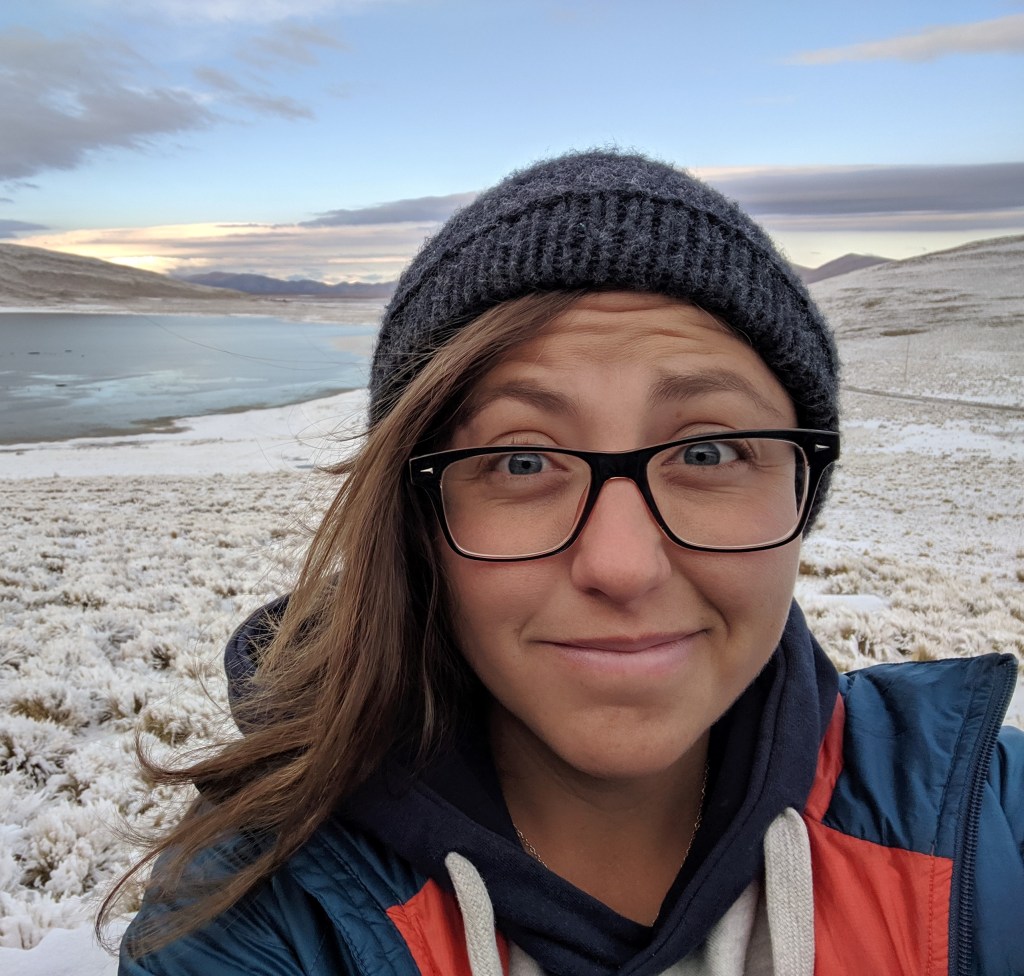
Dr. Sara Juengst is a professor at UNC Charlotte and specializes in bioarcheology and Andean archaeology. She earned her B.A. from Vanderbilt University and her PhD from the University of North Carolina at Chapel Hill. She has conducted research in Bolivia, Peru, and Ecuador, as well as worked on field projects in Southeastern U.S.
What area do you work in/what is your field of study?
I am a bioarchaeologist, which means I study human skeletons and burial sites from archaeological sites. I am particularly interested in how people’s identities and social relationships impacted their lives, which is something we can actually see from bones since a lot of our experiences affect our skeletons. For example, what you eat changes what your teeth look like, many diseases can affect your skeleton, and broken bones are visible even years after healing!
What do you like most/what is most interesting about your job?
Most of the year, I teach at the University of North Carolina at Charlotte, balanced with summer fieldwork and year-round writing projects. I love most aspects of the job, but teaching in classrooms and on field schools is particularly fun. I like seeing people find a connection with the past, in ways maybe they didn’t expect. And it’s fun when this happens for me too! I appreciate that I get to “witness” the past and past peoples in ways that most people don’t.
What kinds of jobs are there in this field (for example, where or who can you work for)?
Many archaeologists are employed by cultural resource management firms who contract with the government or businesses to assess areas for archaeological sites before construction begins, or if there is any reason to think an area might be threatened by some natural process, among other reasons. Archaeologists also work for universities and museums, where they often have a bit more flexibility and control over what and where they research. Some bioarchaeologists also work with coroner’s offices and police departments to consult on forensic cases.
How do you think archaeology/anthropology/paleontology is being brought into the modern age?
Recently, I think archaeologists are asking more socially relevant questions and working alongside descendent communities to produce really exciting scholarship. While new technology is always fun, I see these changes as how archaeology will be “modernized” – incorporating more diverse voices not only makes the field more equitable but also improves the quality of our research.
As a woman, what challenges have you faced in this field?
For some reason, bioarchaeology has many more women practitioners compared to archaeology more broadly. But there are of course still challenges, from differing cultural perspectives on what are appropriate roles for women to occupy to having to “prove” my expertise more often than my male colleagues. I’ve been lucky to have a supportive network of scholars of all genders so while these challenges are real, I haven’t felt the burden too heavily.
How did you first get started in this field and/or what were some of the most important steps or influences on your journey to becoming a scientist in this field?
I kind of accidentally stumbled into archaeology. I thought I would be a sociology major in college, maybe do something in social work, and randomly took an anthropology class to fulfill a general education requirement. I really enjoyed it and started taking more classes, eventually participating in a field school in Peru. Being able to travel, work, and live in a small town in such a different cultural, geographical, linguistic, etc context was really eye-opening and I knew I wanted to keep doing that. After college, I took a year off and worked in a museum before applying to graduate school. I think this was critical for a few reasons – getting a break from school was important to see what life outside academia is like, and it gave me time to sort through my various interests and focus my proposal for a PhD project. My undergraduate and museum mentors were invaluable to the process and definitely helped a lot. I still go back to them for advice!
My Reflection:
First off, I just want to say thank you for Dr. Juengst for taking the time to answer my questions! I was super intrigued by her answers. It was really interesting to read Dr. Juengst’s perspective on bioarcheology and what she does as a bioarcheologist, because I have actually already interviewed a bioarcheologist (Dr. Stewart), but her perspective was quite different from Dr. Juengst’s, so it was cool to get that duality. I really liked how Dr. Juengst talked about how she can use the remains of people to examine social structures and relationships, because I had never really thought about just how far the evidence from these bodies can go, but it is really interesting to think about how they can help us to form a more coherent idea of what society looked like thousands of years ago. Lastly, I also really appreciated how she talked about how the future of archaeology and anthropology is in having more diverse voices because I definitely agree that that is a very important aspect of the advancing field. Once again, thank you Dr. Juengst for doing this interview, I learned a lot!

 The Rosalind Project