Dr. Ashely Stewart is a the Senior Bioarchaeologist at her company, Tennessee Valley Archaeological Research. She earned her PhD in Anthropology from the University of Alabama, where she focused her research in bioarchaeology, dental anthropology, and mortuary analysis. She has over 10 years in archaeological investigational experience.
What area do you work in/what is your field of study?
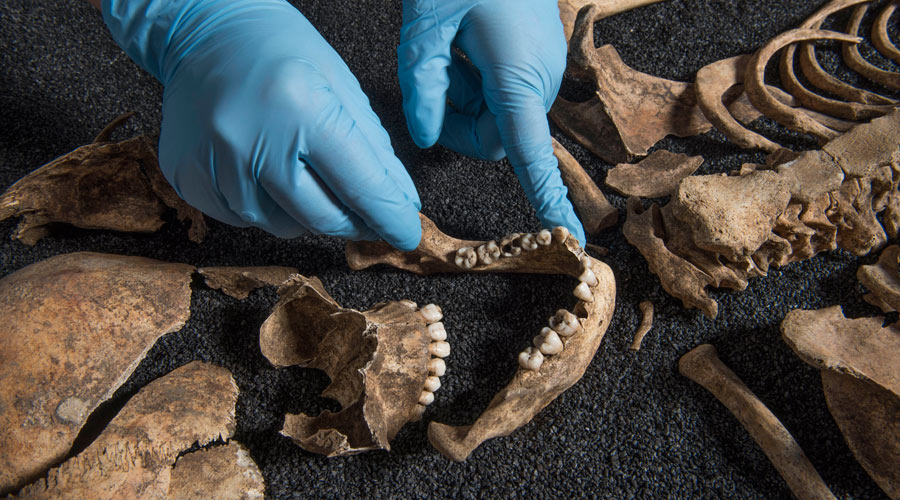
I am a bioarchaeologist, meaning I look at human remains and mortuary contexts to learn about life in the past.
What do you like most/what is most interesting about your job?
Examining the past through human remains is fascinating. For example: you can talk about warfare, examine the weapons used or fortifications built, but seeing the impact warfare had on actual human bodies is astounding. You can view the impacts of events and history on a personal level when doing osteological work. It is a way to get a very intimate view of life in the past, unlike through any other means.
What kinds of jobs are there in this field (for example, where or who can you work for)?
The main job everyone thinks of is in academia, which is a great profession but can be hard to get into or just might not be for everyone. Cultural Resource Management (CRM) is another great option for people interested in archaeology; you get to make sure that cultural sites, resources or materials are not being damaged or destroyed by things like infrastructure or utility work. Archaeologists are also regularly employed by the National Parks Service to preserve, conserve, and protect the archaeological resources in the parks. People with a forensic/bioarchaeological and archaeological background can also do work recovering and identifying human remains of people who were MIA or POWs in past wars or conflicts, or even from mass fatality situations. There are lots of options for employment in this field!
How do you think archaeology/anthropology/paleontology is being brought into the modern age?
I am not a paleontologist, so I can’t speak to that, but there have been lots of advances in archaeology and anthropology in recent years. The use of ground penetrating radar (GPR) is being used to detect subsurface objects or anomalies; GPR can help determine what areas of a site will likely be the best to excavate and also indicate if certain areas should be avoided. It has successfully been used to identify old roads, buried structures, and other archaeological features through nondestructive means. Light detection and ranging (LiDAR) is another useful tool. Unlike GPR, LiDAR does not penetrate into the ground, but is used to generate 3D information about the earth’s surface and the objects on it. It is a very accurate system and can identify anomalies for future archaeological investigation. Another useful program is Geographic Information Systems (GIS). GIS software can be used in archaeology to not only map newly discovered sites, but examine old ones in new ways. For example, in GIS, you can select two nearby points (or sites) and ask GIS to calculate the most efficient path between the two sites based on the landscape. This is called the “least cost path” and can help you see how people were likely going to and from neighboring sites or even help deduce likely transportation networks. In bioarchaeology, DNA and isotope analysis have also been extremely informative. DNA can help identify genetic relations between individuals, and isotope analysis can determine where an individual was born, as well as what regions of the world a person spent a lot of time in. This can be helpful in identifying unknown individuals, or in archaeological contexts, can be used to examine migration.
As a woman, what challenges have you faced in this field?
Bioarchaeology tends to be a female dominated field, and archaeology tends to be a very progressive discipline, but that does not mean there are no challenges. Some of the older generations still have trouble viewing females as leaders or being capable of handling an excavation. Luckily, I have not run into many of these individuals in my time as an archaeologist, but it does happen.
How did you first get started in this field and/or what were some of the most important steps or influences on your journey to becoming a scientist in this field?
I took an archaeological field school through Auburn University when I was an undergraduate there, which really set me on the path I am on today. From there, I took all the archaeology classes offered at Auburn, and kept seeking out additional field schools for the summer months. I found one in Romania, and ended up spending two summers there working on a Roman forum. After I graduated from Auburn, I was still unsure exactly how I wanted my career to go. I happened upon a bioarchaeology field school in Greece, and applied to be a part of that the following summer. That experience solidified for me that I wanted to concentrate in bioarchaeology, so that is what I applied for in graduate school and have been doing bioarch ever since.
Do you think that as we advance in time, we are running out of archaeological ‘discoveries’ (for lack of a better word)? Or, how do you see the future of this field of science playing out?
I think we will never know everything there is to know about the past, so there will always be new things to discover, especially as science progresses.
Is it difficult to learn how to find artifacts or dig for them?
No – but the best way to learn is by going to a field school. There you will learn all the techniques used in archaeological excavation. There are field schools all over the world to choose from and on any time period you are interested in.
What is the coolest thing/artifact you’ve ever found/worked with?
The absolute coolest excavation has to be “vampires” in Poland. I help teach a field school there, and it is common to see anti-demonic or anti-vampiric activity in the graves. Basically, the people who lived in this area believed in vampirism; when a person had an “unusual death” (suicide, drowning, etc.), there were fears that that person could become a vampire, so people in the community took protective measures to prevent this. We’ve uncovered people buried with rocks piled on their necks to prevent them from rising, people with scythes or knives across their necks to do the same, or even decapitated individuals. I think these will be very hard to top.
My Reflection:
First of all, I just loved reading Dr. Stewart’s responses! I’m so thankful that she took the time to thoroughly answer them for me, and I’ve definitely learned a lot, even in these few paragraphs. I really enjoyed what she had to say about how examining human remains is a very intimate way of looking at the past, because I completely agree! I feel like there are few other ways you can get such a direct insight into what life was like for people in the past, and more importantly, how the world and its occurrences affected them physically. I also really appreciated the breakdown Dr. Stewart gave me of some of the different technology used in this field, like LiDAR, GPR, and GIS. I have actually seen LiDAR being used in a documentary I watched, but it was really interesting to read about each one and the differences and uses. Lastly, it was so cool reading about the “vampires” in Poland! I had never even thought about vampirism or the lengths people might take to combat it, so it was cool to learn about that. I am so grateful to Dr. Stewart for contributing to my project, so thank you Dr. Stewart for your answers, I’ve really enjoyed learning a bit more about bioarchaeology!
 The Rosalind Project